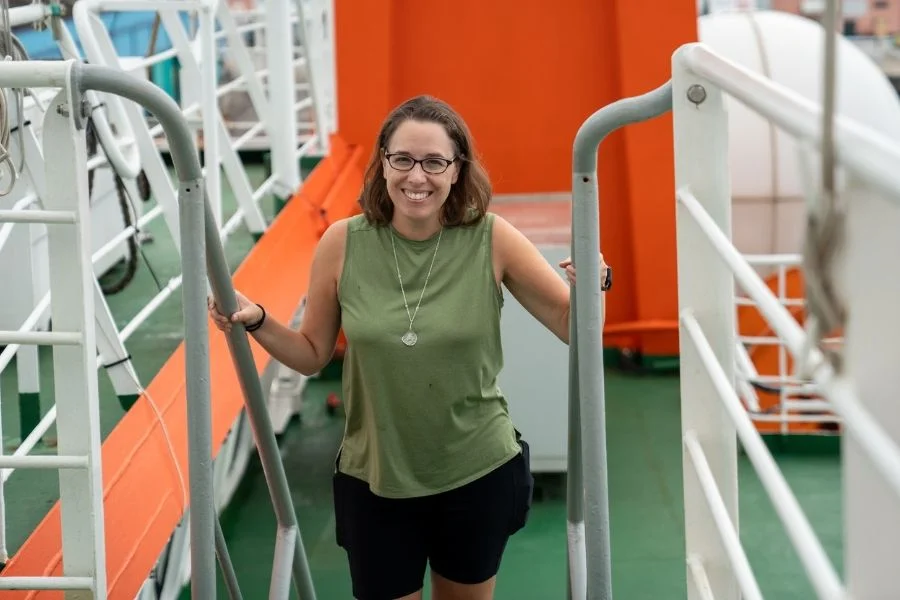
Allison Wing is the first FSU faculty member to win the American Geophysical Union's Atmospheric Sciences Ascent Award, for work on how hurricanes first form.
A Florida State University meteorologist whose research looks at how hurricanes first take shape has won a national award from the American Geophysical Union.
Allison Wing is an associate professor of meteorology and environmental science. She is the first FSU faculty member to receive the union’s Atmospheric Sciences Ascent Award, FSU said Friday.
The American Geophysical Union is a nonprofit for Earth and space scientists. FSU said it represents more than 500,000 professionals worldwide. Since 2012 the union has given the Ascent Award each year to four mid-career scientists. Wing will receive hers at the union’s annual meeting in San Francisco in December.
What her research found
The award recognizes Wing’s work on tropical thunderstorms and hurricanes. Her key finding, as FSU described it, is that the way clouds interact with thermal radiation helps thunderstorms cluster into larger, organized systems. That process shapes the earliest stage of a hurricane, well before any rapid strengthening.
FSU said the results suggest forecasts could improve if weather models took better account of those cloud and radiation effects when a storm is forming.
“Florida is no stranger to hurricanes, including those that rapidly intensify close to landfall like Helene, a Category 4 that directly hit Perry, Florida, approximately 40 miles from Tallahassee, in 2024,” Wing said. “While forecasts have improved in recent decades, we still have challenges to overcome in predicting intensity, especially when storms strengthen quickly.”
Her projects
FSU listed these parts of Wing’s work:
- She has led the Radiative-Convective Equilibrium Model Intercomparison Project, or RCEMIP, for a decade. It compares how weather and climate models simulate a simplified tropical atmosphere.
- In 2024 she led PICCOLO, the U.S. part of an international field campaign over the tropical Atlantic. Her team used Colorado State University’s Sea-Pol radar on the German research ship Meteor to measure clouds and rain between Barbados and Cape Verde.
- She won an FSU Developing Scholar Award in 2024 and a National Science Foundation CAREER Award two years earlier.
Wing joined FSU as an assistant professor in 2016. Before that she was a National Science Foundation postdoctoral fellow at Columbia University’s Lamont-Doherty Earth Observatory. She earned her doctorate in atmospheric sciences from the Massachusetts Institute of Technology in 2014.
“The award also reflects the exciting work of my students and postdocs, and mentoring them is the most rewarding thing I do,” Wing said.
Michael Stukel chairs FSU’s Department of Earth, Ocean, and Atmospheric Science. He said the award shows the department’s national standing in tropical weather, hurricane and climate research, “topics that are particularly important to Florida.”
What it means for you
- Hurricane forecasts for the Big Bend rely on research like this. Wing’s work targets the hardest part to predict: how strong a storm gets, and how fast.
- Hurricane season ends Nov. 30. Our hurricane prep for Leon County page has sandbag sites, shelter information and the county’s storm information line.
- More on FSU’s weather and climate research is on the Department of Earth, Ocean, and Atmospheric Science website.
Related: FSU neuroscientist wins $2.5M NIH grant to study salt taste and power outages in Tallahassee.
Have your say