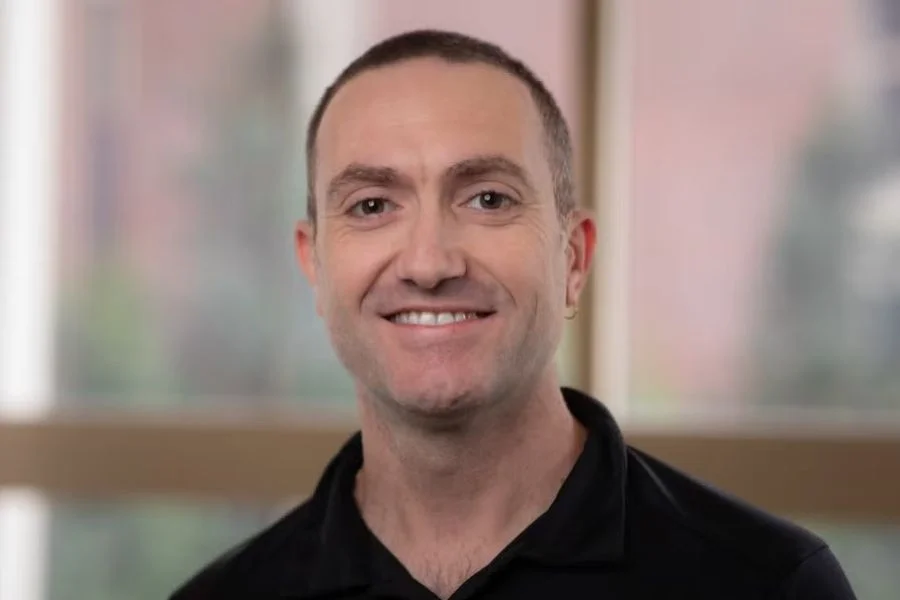
FSU's Roberto Vincis has $2.5 million from the NIH to study how a food's temperature changes the way the brain tastes salt. The grant runs to July 2031.
A Florida State University neuroscientist has won a $2.5 million federal grant to study how the temperature of food and drink changes the way the brain tastes salt.
Roberto Vincis is an associate professor of biological science and neuroscience. The money comes from the National Institute on Deafness and Other Communication Disorders, part of the National Institutes of Health, FSU said Monday.
The project is called “Thermal Influences on Salt Taste Sensitivity and Neural Processing.” The NIH’s own RePORTER database lists it as award 1R01DC023553. It runs from Sept. 1, 2026, to July 31, 2031, and its first-year award is $369,413.
What the lab will study
“Temperature strongly shapes what we choose to eat, yet we know surprisingly little about how it affects the way the brain processes taste,” Vincis said in the university’s announcement.
The team will look at table salt and salt substitutes served at different temperatures. FSU said the work will combine:
- behavioral experiments
- recordings of brain activity
- targeted manipulation of specific brain circuits
“What we learn could help develop strategies to reduce excess salt consumption in the diet,” Vincis said.
The health stakes are large. About 90% of Americans eat more sodium than recommended, according to the U.S. Food and Drug Administration. Too much salt raises blood pressure and the risk of heart disease and stroke, according to the Centers for Disease Control and Prevention.
Lisa Eckel directs FSU’s Program in Neuroscience. “By uncovering how multiple sensory systems interact to drive unhealthy dietary preferences, this research could also help to identify novel biological targets for treating obesity and eating disorders,” she said.
A lab with a run of federal awards
Vincis joined FSU in 2018. RePORTER lists a second new NIH award for his lab this fall: a two-year grant titled “A novel approach to study the neural mechanisms of flavor,” which began Sept. 18, 2026, with $423,500. He also holds a five-year NIH grant from 2022 on taste processing in the brain, which FSU put at $1.8 million.
This year he received the Ajinomoto Award for Young Investigators in Gustation from the Association for Chemoreception Sciences, the university said.
NIH money in Tallahassee is falling
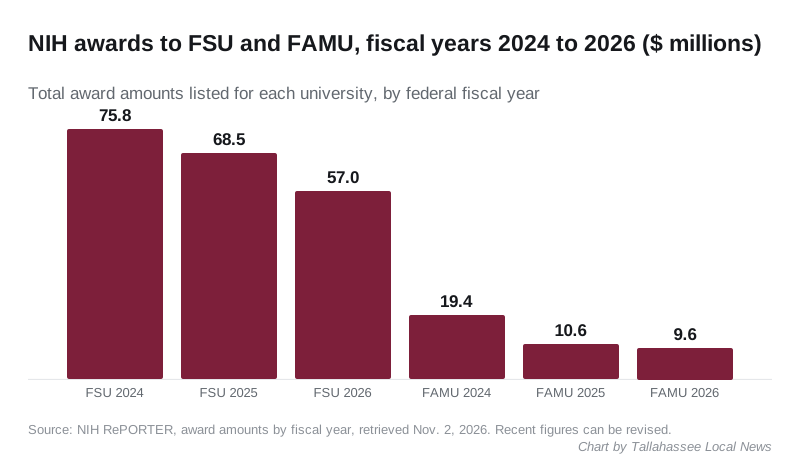
The new grant arrives as overall NIH funding to Tallahassee’s universities has dropped for two years running. RePORTER lists these award totals by federal fiscal year, which runs Oct. 1 to Sept. 30:
| University | 2024 | 2025 | 2026 |
|---|---|---|---|
| Florida State University | $75.8 million | $68.5 million | $57.0 million |
| Florida A&M University | $19.4 million | $10.6 million | $9.6 million |
FSU’s listed total for 2026 is about 25% below 2024, and FAMU’s is about half. The database counted 96 FSU awards in 2026, against 129 in 2024. NIH can still revise recent years, so the 2026 figures may change.
What it means for you
- The research is basic science in a lab, not a clinical trial. FSU has not said it is recruiting volunteers.
- The work feeds FSU’s Institute for Connecting Nutrition and Health and the FSU Health academic system, which opened its new research building last week.
- Federal research grants pay for lab jobs and graduate students in Tallahassee. You can look up any local award by name or school in NIH RePORTER.
More FSU science news: the MagLab’s $18 million magnet award.
Have your say